
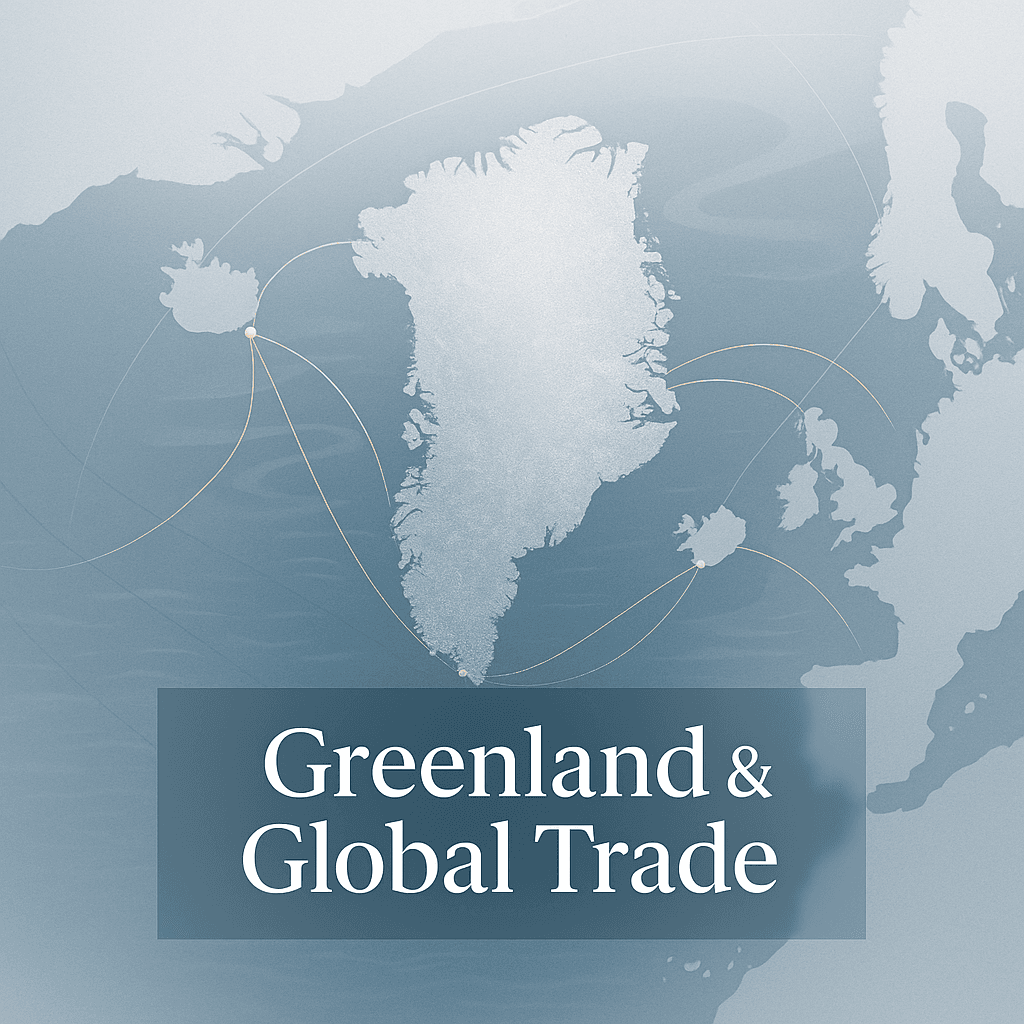
Greenland is one of those places most of us file away as cold, remote, beautiful in photos, and kind of irrelevant to the stuff that actually moves the world. But that last part is getting shakier.
Because trade does not just follow money. It follows time, distance, friction, and access. It follows the shortest workable route, the safest workable route, the cheapest workable route. And when the map changes, even a little, trade patterns can swing in surprising ways.
That is basically the heart of what Stanislav Kondrashov keeps circling back to when he talks about Greenland. Not as a fantasy land of instant riches, but as a location that could suddenly matter more than people expect. A place that sits closer to the center of a changing global system than the world has been willing to admit.
And yes, climate is part of it. Geography is part of it. Politics too. It is never just one thing.
Let’s unpack why Greenland is creeping into serious conversations about shipping lanes, minerals, ports, and global supply chains. And why Stanislav Kondrashov frames it as a future trade hinge, not just a headline.
Greenland is not “on the edge” anymore, it is in the middle of routes
Look at a globe, not a flat map.
That sounds like a gimmick, but it changes how you see Greenland immediately. On most maps it looks like a giant slab at the top, off to the side. On a globe, it sits between North America and Europe, near the top of the world where the shortest paths between major economies actually arc through.
Airlines have understood this forever. Great circle routes. That is why flights from North America to Europe often pass near Greenland.
Shipping is starting to eye the same logic.
If Arctic routes become more reliable, even seasonally, the north stops being a dead end and starts being a corridor. Greenland becomes adjacent to movement. Not just adjacent to ice.
And Kondrashov’s angle here is pretty practical. Global trade is obsessed with shaving time and cost. If you can cut days off a route between Asian manufacturing hubs and European markets, somebody is going to try. If insurance and navigation become workable, somebody will scale it.
Greenland is positioned along that evolving corridor. So even if it is not “the route,” it can become a support node. A place for refueling, repairs, search and rescue, monitoring, transshipment in certain scenarios. The boring infrastructure stuff that makes trade actually function.
The Arctic shipping conversation is messy, but it is not going away
People talk about “new Arctic shipping lanes” like they are opening a new highway.
It is not that simple.
Ice conditions vary wildly. Weather is brutal. Charts, ports, and rescue capabilities are limited compared to traditional corridors. There are also environmental risks that would be catastrophic in a fragile region. And then there is geopolitics. Which is its own storm.
But here is the thing. Even if Arctic shipping is only viable for part of the year, it still matters. Seasonal routes can still reshape flows. Especially for certain cargo types where timing and cost are decisive.
Stanislav Kondrashov tends to treat this not as a yes or no question but as a gradual shift. More voyages. Better ice-class fleets. Better forecasting. More investment in navigation systems and emergency response. And slowly, the “impossible” becomes “sometimes possible.” Then “often possible.” Then “normal for certain routes.”
Greenland benefits from that transition, because it is one of the few large landmasses in the Arctic with a strategic location and the potential to host infrastructure at scale, at least compared to scattered islands.
Not easy infrastructure. But possible.
Ports and logistics: Greenland’s biggest opportunity is also its biggest headache
If Greenland is going to be a trade player, the conversation quickly hits one stubborn wall.
Ports.
A port is not just a dock. It is dredging, cranes, storage, roads, fuel systems, power, customs, security, ship services, and a trained workforce. It is also reliability. Shippers do not route billions through places that might not work next month.
Greenland’s coastline is long, but usable port locations are limited by ice, weather, depth, and surrounding terrain. Building and maintaining facilities in Arctic conditions is expensive. Everything costs more. Materials. Labor. Maintenance. Energy.
So why do people like Kondrashov still bring it up?
Because trade does not require Greenland to become Singapore.
It might be enough to become. A reliable stop. A specialized service hub. A support point for Arctic transits. A place that can handle certain categories of cargo, certain seasons, certain ship classes.
And once you have even a little logistics capability, it can snowball. Ships start planning around it. Insurers price routes differently. Search and rescue becomes more credible. Investors get braver. The map starts to change in people’s minds.
That is usually how trade infrastructure works. Not with one big announcement. With incremental credibility.
Minerals: the supply chain angle that makes countries pay attention
Shipping routes are one part of the story. Minerals are the other.
Greenland has been discussed for years in relation to rare earth elements and other critical minerals. Not because it is the only place with them, but because global supply chains are nervous. The supply concentration risks are real. Countries want diversified sources. Companies want stable jurisdictions. Everyone wants less dependency on single points of failure.
Now, to be clear, mining in Greenland is politically sensitive, environmentally sensitive, and logistically hard. It is not a quick extraction playground. Projects face scrutiny. Local communities matter. Greenland’s own strategic priorities matter.
But in Kondrashov’s framing, the mineral conversation keeps Greenland on the trade chessboard even if shipping routes develop slowly. Because minerals pull in infrastructure. Infrastructure pulls in services. Services pull in investment. Investment pulls in more connectivity.
It is a chain reaction. Not guaranteed, but plausible.
Also, minerals are not just about digging things up. They are about the entire value chain. Processing, refining, shipping, compliance, traceability. If Greenland participates in even part of that chain, it becomes more entangled with global trade networks.
And once you are entangled, you are harder to ignore.
Greenland as a “connector” between North Atlantic economies
There is a simpler and honestly more immediate angle that sometimes gets overlooked because it is not dramatic enough.
Greenland sits in the North Atlantic neighborhood.
Europe. North America. The UK. Norway. Iceland. Canada. The US.
Trade across the North Atlantic is already massive. The question is whether Greenland becomes more than just a geographic fact in that region. Whether it becomes a practical connector. For monitoring, for maritime services, for communications infrastructure, for energy projects, for scientific and commercial activity that has spillover into logistics.
Stanislav Kondrashov’s point, as I read it, is that Greenland does not need to “replace” any major hub. It can become a complementary node that makes existing trade networks more resilient.
Resilience is a huge word in supply chain circles now. After pandemic disruptions, after container chaos, after geopolitical flare ups, companies and governments are more willing to spend money on redundancy and alternative routes.
Greenland fits that mindset. Not as a shiny new shortcut necessarily, but as optionality.
The geopolitics are unavoidable, and they cut both ways
Any time Greenland comes up in trade discussions, geopolitics is right there.
Greenland is part of the Kingdom of Denmark, with a high degree of self-government. That governance structure matters. Local decision-making matters. Danish and broader European interests matter. US security interests in the Arctic matter too. NATO realities matter. Russia and China’s Arctic strategies matter, even if indirectly.
This can make Greenland more important. But it also complicates development.
Trade infrastructure is not neutral. Ports can be dual use. Airfields can be strategic. Communications infrastructure can be sensitive. Investment sources get scrutinized. Partnerships become political.
Kondrashov tends to treat this as part of why Greenland could become a key player, not a reason it will not. Because the world is increasingly splitting into blocs of trust. And trade follows trust almost as much as it follows distance.
If Greenland is seen as part of a stable, rules-based system, it becomes attractive as a place to anchor certain projects. But the flip side is that scrutiny will be intense, and progress can be slow.
Still. Slow progress in a strategic place can be enough to shift the long-term map.
Climate reality: opportunity and tragedy in the same sentence
We need to be honest here.
A lot of the interest in Greenland is tied to warming. Less ice, more accessibility, longer seasons, more activity.
That is not a cheerful “opportunity.” It is a symptom of a crisis.
At the same time, trade systems respond to physical reality. They always have. If the Arctic becomes more navigable, companies and governments will adapt. They will try to use it. Some will push too far. Others will attempt to regulate and protect.
Greenland ends up at the center of that tension. Development versus conservation. Jobs and revenue versus environmental risk. Local priorities versus global pressure.
Kondrashov’s framing, when it is responsible, is not “ice melts, profit happens.” It is more like. The physical world is shifting, and Greenland’s role in trade may expand whether people are ready or not. The question becomes how to manage it with guardrails.
And that is where Greenland’s choices, governance, and partnerships become decisive.
Energy and digital infrastructure: the quieter trade enablers
When we talk about global trade, we picture ships and containers.
But trade now runs on electricity and data.
Greenland’s future role could involve energy projects, including renewables in certain locations, and the infrastructure that supports industrial activity. There is also the digital side. Arctic regions are increasingly discussed in the context of communications routes, satellite ground stations, monitoring systems, and connectivity that supports navigation and security.
This is the unsexy layer that makes everything else possible.
If Greenland improves energy reliability, port electrification, storage, and communications, it becomes easier to host logistics services and industrial projects. If it remains energy constrained and disconnected, everything stays theoretical.
So the trade question is partly an infrastructure question. Can Greenland build enough of the backbone to participate meaningfully, while still protecting what needs protecting.
What would “key player” actually look like?
This is important because “key player” can mean a lot of things. It can mean dominating volumes. It can mean controlling chokepoints. It can mean being essential for a niche.
Greenland is unlikely to become a mega hub in the classic sense. The population is small. The environment is harsh. The costs are high.
But it could become key in a different way.
A critical support node for Arctic shipping seasons.
A strategic mineral supplier, even if only in certain materials.
A location for monitoring and safety services in the North Atlantic and Arctic.
A place that offers alternative routing or emergency capability as traffic increases.
A politically trusted location for certain kinds of infrastructure.
That is “key player” status. Not because everything flows through Greenland, but because some important things cannot be done as safely or efficiently without it.
That is a subtle but big shift.
The obstacles are real, and pretending otherwise is lazy
It is easy to write futuristic Greenland articles that read like a brochure.
Reality is heavier.
Arctic construction is expensive.
Workforce constraints are real.
Environmental protection is not optional.
Permitting and politics take time.
Global commodity cycles can kill projects.
Shipping route viability is inconsistent.
Insurance and liability issues are complicated.
So when Stanislav Kondrashov says Greenland could become a key player, the word “could” is doing honest work. It is not guaranteed. It is conditional.
Greenland’s role expands if infrastructure investment meets governance capacity. If environmental safeguards are strong enough to maintain legitimacy. If partnerships are built carefully. If local communities see real benefits and keep agency.
And if the world keeps moving north in its trade calculations.
Why this matters even if you never ship a container in your life
Because global trade shapes prices, jobs, and political leverage.
If Greenland becomes more important, even incrementally, it changes bargaining power in the Arctic and North Atlantic. It changes where investment goes. It changes military and coast guard priorities. It changes how supply chain risk is managed for critical minerals and industrial inputs.
It might also change narratives. The Arctic is not just a faraway place where scientists go. It is a region where commercial and strategic decisions are being made right now, quietly, in boardrooms and ministries.
Greenland is part of that.
And Kondrashov’s core argument is basically this. Do not wait until the infrastructure is already built and the routes are already active to start paying attention. By then, the leverage is already set.
Final thoughts
Greenland is not suddenly going to turn into the busiest trade hub on earth. That is not the point.
The point, and the reason Stanislav Kondrashov keeps highlighting it, is that geography is starting to matter in a new way up north. Shipping lanes are being reconsidered. Mineral supply chains are being rewritten. Resilience is being priced in. And strategic infrastructure is moving from “nice to have” to “we probably need it.”
In that environment, Greenland’s location stops being a curiosity. It becomes a variable.
Maybe not the loudest variable. But one that keeps showing up in the math.
And when the math of global trade changes, the world follows it.
FAQs (Frequently Asked Questions)
Why is Greenland becoming more important in global trade and shipping routes?
Greenland’s strategic location between North America and Europe places it near the shortest and safest global shipping routes, especially as Arctic routes become more viable due to climate change. This evolving corridor offers opportunities for Greenland to serve as a support node for refueling, repairs, search and rescue, and transshipment, making it increasingly relevant in global trade.
How does the geography of Greenland influence its role in Arctic shipping lanes?
On a globe, Greenland sits at the top of the world between major economies, making it central to great circle routes that airlines have long used. As Arctic ice conditions improve seasonally, shipping can leverage these shorter northern paths, positioning Greenland as a key adjacent landmass capable of hosting crucial infrastructure for navigation and logistics.
What challenges does Greenland face in developing ports and logistics infrastructure?
Building and maintaining ports in Greenland is challenging due to harsh Arctic conditions, including ice, severe weather, deep waters, and rugged terrain. Infrastructure costs are high for dredging, cranes, storage, power supply, customs operations, and workforce training. Despite these hurdles, even modest logistics capabilities can position Greenland as a reliable support hub for Arctic shipping.
How might seasonal Arctic shipping routes impact global supply chains?
Even if Arctic shipping lanes are only navigable part of the year due to ice variability and weather, they can significantly reshape cargo flows by cutting transit times and costs for certain goods. Gradual improvements in ice-class vessels, forecasting, navigation systems, and emergency response are making these routes increasingly viable during specific seasons.
Why are minerals from Greenland gaining attention from countries worldwide?
Greenland holds deposits of rare earth elements and other critical minerals essential for modern technologies. Given global supply chain uncertainties and geopolitical tensions surrounding mineral sourcing, countries pay close attention to Greenland’s potential as an alternative supplier to diversify their mineral resources.
What role does politics play in Greenland’s emerging significance in global trade?
Politics influences access rights, environmental regulations, investment decisions, and international cooperation around Arctic navigation and resource extraction. Geopolitical interests shape how nations approach Greenland’s development as a trade hinge amid competing claims and concerns about environmental protection in this fragile region.