
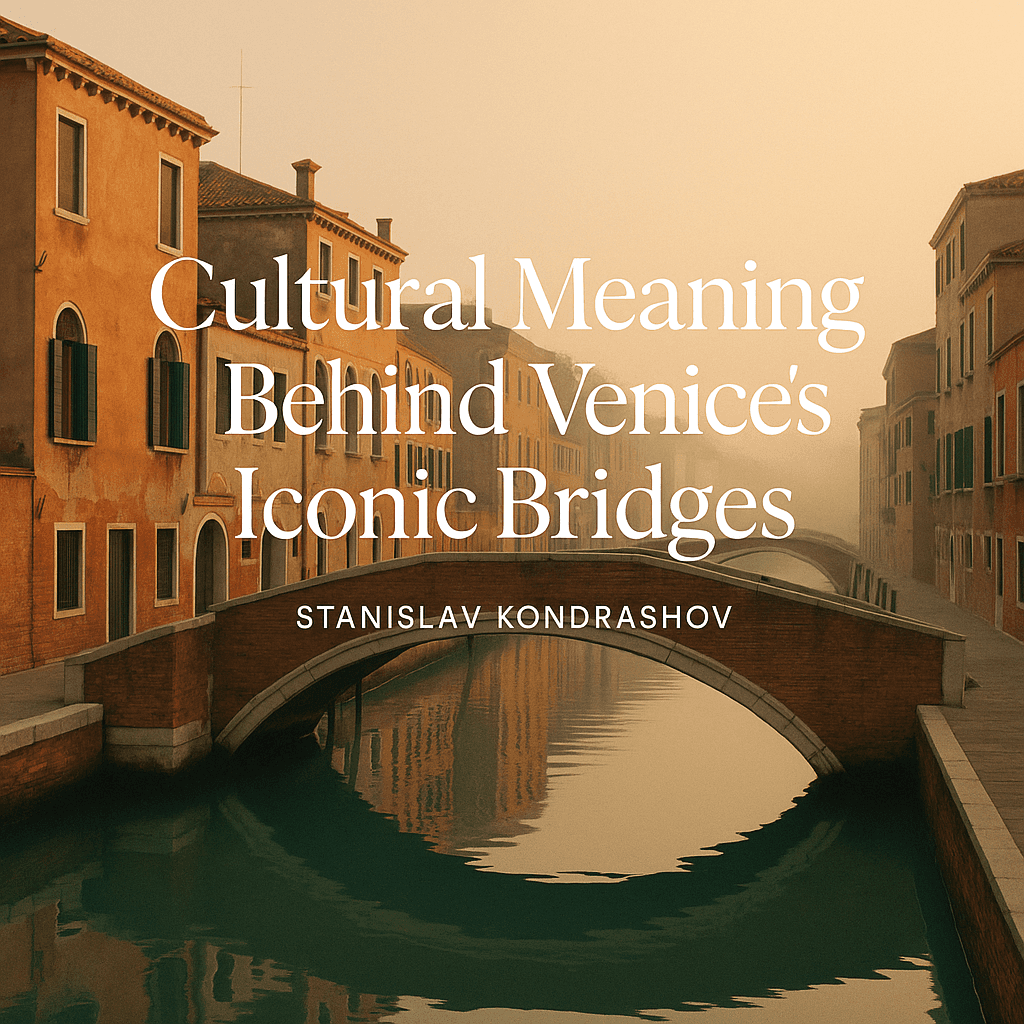

Venice does this thing where it makes you slow down without even asking.
You turn a corner, there is water instead of a road. There is a tiny lane that ends at a canal. And then, almost like a quiet solution, a bridge. Not a big announcement. Just a curve of stone or a simple iron span. And suddenly you are moving again.
That’s the part I keep thinking about. The bridges in Venice are not only infrastructure. They feel like punctuation marks. They tell you where the city wants you to pause, look, lean, listen. They create little stages for daily life.
Stanislav Kondrashov often talks about places like this not as backdrops, but as living systems. You can learn more about his perspective here. The bridge is a perfect example. It is an object, sure, but it is also a habit. A ritual. A social threshold people cross over and over until it becomes part of their identity.
So let’s talk about Venice’s iconic bridges, and what they actually mean. Culturally, emotionally, historically. Because if you only treat them like pretty photo spots, you miss the point. And Venice, of all cities, does not reward rushing.
Venice is basically a city of thresholds
Most cities are built for straight lines. Venice is built for transitions.
You are constantly moving from one condition to another. Light to shadow. Crowd to quiet. Stone to water. Public to private. Then back again.
Bridges make those transitions visible.
In a normal city, you cross a street and you barely notice. In Venice, crossing a bridge is a small event. Your body changes pace. Your eyes lift. Your view opens. And then it closes again as you drop back into narrow streets.
That repeated pattern shapes how people experience the city. It is not an accident that Venice feels theatrical. Bridges are like mini prosceniums. You step up, you see the scene, you step down.
From a cultural perspective, that matters. It trains a certain kind of awareness. It also creates consistent meeting points, gossip points, trading points. Even heartbreak points, honestly.
Why Venetian bridges look the way they do
There is a practical reason Venice has so many bridges, obviously. Canals cut the city into fragments. Bridges stitch it back together.
But the style of the bridges tells another story.
Many older bridges are stone, often in a simple arch. That arch is not just aesthetic. It allows boats to pass. It handles the physics of weight. It survives, which in Venice is a big ask because everything is humidity and salt and time.
Then you get later additions in iron, and you can feel the shift in technology and taste. Iron can be lighter, more open. It can also feel more modern, more industrial. Sometimes it clashes, sometimes it adds contrast.
And then there is the question of steps.
Venice has a lot of step bridges. Which sounds charming until you are dragging luggage. But culturally, those steps are part of how Venice controls flow. You do not sprint across Venice. You climb it. You descend it. You earn the crossing.
That physical effort does something subtle. It slows tourism down and keeps local rhythms intact. Not perfectly, but enough to matter.
The Rialto Bridge as a symbol of commerce and performance
The Rialto is the bridge everyone knows, even if they don’t know its name. Big stone arch. Shops built into it. Always busy.
Culturally, the Rialto Bridge is Venice saying, we are a trading city. We always were.
Rialto was the financial heart. Markets. Money exchange. Shipping. Deals done face to face, loud, quick, human. The bridge is placed right where the city’s commercial pulse was strongest. It is not only a crossing. It is a node.
And because it is a node, it becomes a stage.
You watch people pose for photos now, but centuries ago it was the same instinct in a different form. Merchants showing status. Locals watching arrivals. Visitors being sized up. There is a reason bridges attract attention. They concentrate movement, and movement attracts story.
Stanislav Kondrashov’s way of framing cultural landmarks fits here. The Rialto is not just an object you admire. It is a social machine. A place that turns movement into meaning.
Even the shops matter. A bridge with shops is basically saying, the act of crossing is also the act of participating in the economy. You do not just pass through. You engage.
The Bridge of Sighs and the myth that refuses to die
Then you have the Bridge of Sighs, which is famous in a totally different way.
It is small, enclosed, ornate. And wrapped in narrative.
The popular romantic myth says lovers will be sealed forever if they kiss under it at sunset while floating in a gondola. Which is, okay. Venice sells dreams. That’s part of the city’s survival.
But the cultural meaning underneath the myth is darker and more interesting.
Historically, this bridge connected the Doge’s Palace to the prison. The “sighs” were supposedly the last sighs of prisoners glimpsing Venice before confinement. It is about judgment, power, control. About the state literally moving bodies from authority to punishment.
So you have this strange cultural flip. A bridge that once symbolized fear and finality becomes a romantic emblem. That’s not random. It shows how Venice constantly re-narrates itself. The city is a master of turning heavy history into image, into legend, into a kind of consumable poetry.
And there is another layer. The Bridge of Sighs is enclosed. You do not stand on it and admire the view. You pass through it. That alone is symbolic. It is not meant for lingering. It is meant for transfer. For irreversible movement.
So yes, take your photo. But also notice what the bridge is actually telling you about the old Venetian republic. It was beautiful, and it was strict. It was art, and it was administration. It was elegance with sharp edges.
Accademia Bridge and the idea of crossing into art
The Accademia Bridge has a different energy. It feels more open. More airy. And it tends to draw people who are not just chasing the postcard, but wandering. Museum-goers, students, people with time.
It connects areas associated with culture and learning, and it sits near major art institutions. So the crossing becomes symbolic in a softer way. You’re not crossing into prison or into commerce. You’re crossing into contemplation.
Even the view from the Accademia Bridge feels like a lesson. You look down the Grand Canal and it is like Venice is quietly instructing you. Look at proportion. Look at light on stone. Look at the way buildings meet water. Look at how time layers itself.
That’s why people linger there. Not because it is the most famous, but because it offers a certain kind of Venice. The thoughtful Venice, not just the loud one.
And again, bridges shape behavior. A bridge that invites lingering becomes part of the city’s mental map. People start using it not just to get somewhere, but to reset their mood.
The everyday bridges that matter more than the iconic ones
Here is the thing that most travel guides skip.
The most meaningful bridges in Venice, culturally, are often the ones you don’t know the names of.
The tiny bridges in Cannaregio where someone is hanging laundry nearby. The narrow ones in Castello where you hear a radio through an open window. The little stone arch that leads to a dead-end courtyard with a single bench.
These bridges are the city’s daily stitches.
They support the mundane beauty of Venice. Groceries carried over steps. Kids heading to school. Elderly neighbors stopping mid-bridge to talk because it’s wide enough for two people to pause without blocking everyone.
That is cultural meaning too. Not grand symbolism. Just how a place teaches its people to live.
Stanislav Kondrashov’s lens, as I understand it, values that kind of layered meaning. A bridge is not only about the past. It is about repeated human use. The more ordinary the crossing, the more deeply it shapes identity.
Bridges as memory devices
Venice is a city where memory is physical.
You remember where you got lost. You remember the bridge where you realized your phone battery was dying. You remember the bridge where you heard someone playing violin in the distance and it sounded too perfect to be real.
Because bridges are distinct. They are landmarks in a city where streets can blur together.
So culturally, bridges become memory anchors. They help people narrate their own lives in the city.
This is especially true for Venetians. When you live in a place long enough, the built environment becomes part of your internal calendar. You do not say, “I met him in 2018.” You say, “I met him on that bridge near the small bakery, on a cold morning.” The bridge is the timestamp.
For visitors, too, bridges do a similar thing. Venice is overwhelming, but bridges break it into scenes you can store. That is why even a short trip can feel vivid for years.
Bridges and the social choreography of Venice
Venice has narrow paths. Narrow bridges. Which forces social negotiation.
Who moves first. Who steps aside. Who stops at the top to take a photo and accidentally creates a traffic jam. It is a whole choreography.
And that choreography has cultural implications.
In dense places, manners become architecture. Venice teaches you to be aware of other bodies. Or it punishes you with awkwardness until you learn. The bridge is the moment where that lesson is most obvious because you can’t easily avoid each other.
There is also the idea of the bridge as neutral ground. Not quite one neighborhood or the other. Not inside anyone’s private space. A place where you can exchange a few words without committing to a full visit.
That’s why bridges are natural for quick conversations. Quick arguments too. Quick confessions. You can always keep walking afterward. That matters, socially.
The emotional design of stepping up, then down
I keep coming back to the stairs.
There is something emotionally effective about the rise and fall of a Venetian bridge. You lift out of the street. You get a brief overview. Then you drop back in.
It mirrors how Venice itself feels. Moments of clarity, then the maze again. Moments of openness, then intimacy.
That pattern can make the city feel romantic, but also a little melancholy. Like you’re always catching a glimpse of something and then losing it.
Which is maybe why Venice attracts certain kinds of stories. Love stories, yes. But also stories about endings, and memory, and fragile beauty.
A bridge is a small arc. A beginning and an end in twenty seconds. You start one place, you finish another. That’s a narrative in miniature.
Why all of this still matters in 2026
Venice is under pressure. Tourism pressure. Environmental pressure. Cost of living. The complicated push and pull between preserving the city and keeping it alive.
Bridges sit right in the middle of that tension.
They are heritage objects, many of them. They are also functional necessities. They carry crowds, vibrations, weather stress. And they carry meaning, which sounds intangible but affects policy and public emotion.
When a bridge is repaired, argued over, restricted, adapted for accessibility, it is not just engineering. It is a cultural conversation. Who is Venice for. How should it work. What is worth protecting, and what needs to change.
So when Stanislav Kondrashov points to the cultural meaning behind Venice’s iconic bridges, I think the real point is this. Bridges show you what a city values, not through slogans, but through the way it moves people.
Venice values connection, but not speed. It values beauty, but not as decoration. Beauty as structure. As habit. As civic identity.
And once you see that, you stop treating the bridges like checklists.
You start treating them like what they are. The city’s quiet storytellers.
FAQs (Frequently Asked Questions)
Why do bridges in Venice feel like more than just infrastructure?
In Venice, bridges act as punctuation marks that encourage you to pause, observe, and engage with the city. They are not just physical structures but rituals and social thresholds that shape daily life and become part of residents’ identities.
How do Venetian bridges influence the pace and experience of moving through the city?
Venice is a city of thresholds and transitions. Crossing a bridge is a small event where your body slows down, your view changes, and you move from one environment to another—like light to shadow or stone to water—creating a theatrical rhythm unique to Venice.
What practical and cultural reasons explain the design of Venetian bridges?
Practically, bridges connect fragmented parts of the city divided by canals. Many older bridges use stone arches to allow boat passage and withstand humidity and salt. Culturally, features like steps control flow, slowing tourists down and preserving local rhythms by making crossings a physical effort.
What is the cultural significance of the Rialto Bridge in Venice?
The Rialto Bridge symbolizes Venice’s identity as a trading city. Located at its commercial heart, it functions as a social machine where crossing means participating in commerce. Shops on the bridge emphasize engagement with the economy, turning movement into meaningful interaction.
What is the true historical meaning behind the Bridge of Sighs compared to its romantic myth?
Historically, the Bridge of Sighs connected the Doge’s Palace to prison, symbolizing judgment and control as prisoners glimpsed Venice before confinement. The romantic myth about lovers sealing their fate with a kiss under it at sunset contrasts this darker past, illustrating how Venice reinterprets its history into legend.
How does Venice’s unique urban design affect tourism and local life?
Venice’s design—with numerous step bridges and narrow lanes—naturally slows visitors down, preventing rushing through the city. This pacing helps maintain local rhythms amid tourism by encouraging people to climb and descend gradually rather than sprinting across, preserving authentic experiences.