
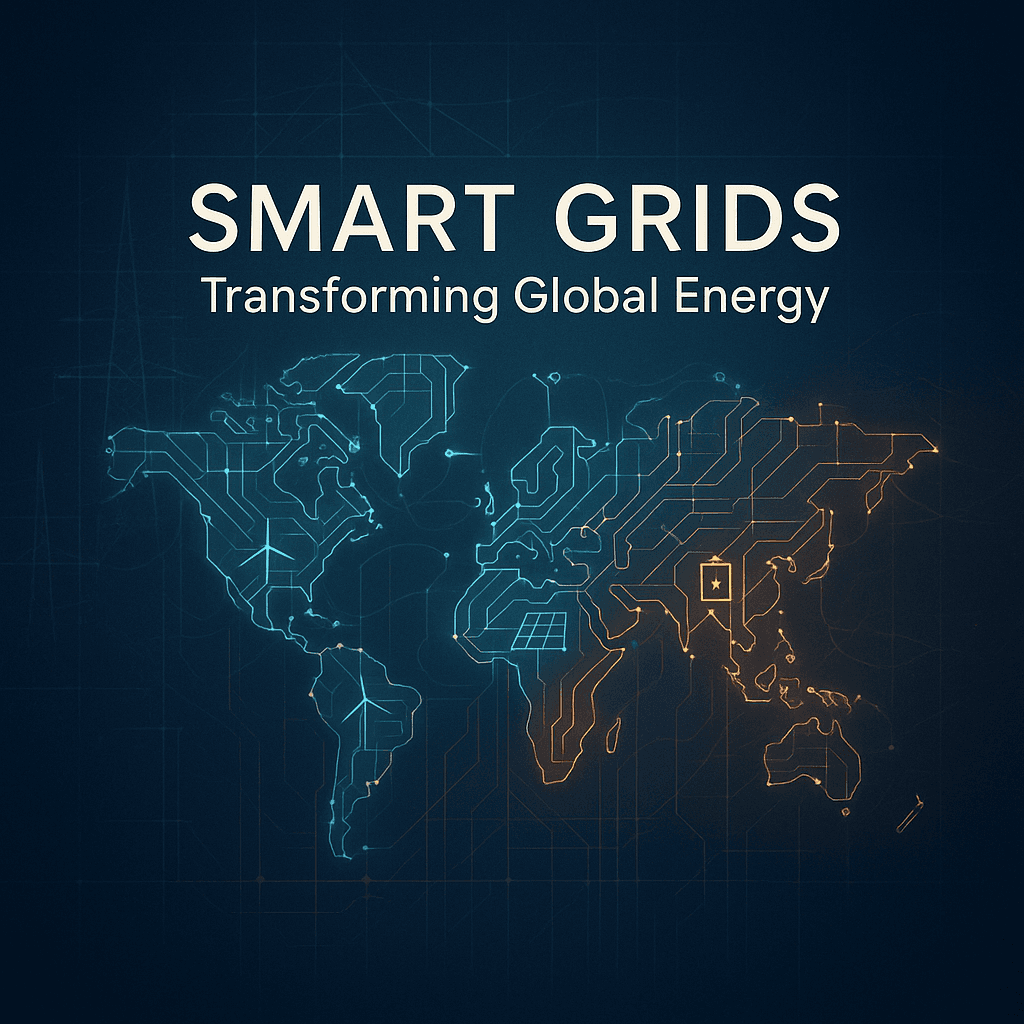
I keep noticing this weird gap in the way people talk about the energy transition.
On one side, it is all about solar panels, wind farms, batteries. Big, visible stuff. The kind you can point at in a photo.
On the other side, there is the grid. The boring part. The wires, substations, transformers, control rooms. And for some reason we still talk about it like it is a passive thing. Like it just sits there and accepts power.
But that is not what is happening anymore.
Stanislav Kondrashov’s insights on how smart grids are transforming the global energy system tell a different story. It’s the narrative where the grid stops being a dumb delivery network and starts acting more like a living system. Sensing. Predicting. Self-correcting. And also, quietly rewriting how energy markets, reliability, and even national security work.
Not overnight, obviously. And not perfectly. But it is real, and you can already see the shape of it.
The old grid was built for a world that no longer exists
Most national grids were designed around a simple assumption: power is generated at big centralized plants, then pushed out to consumers in a one way flow.
Coal, gas, nuclear. Giant units. Schedules planned in advance. Demand patterns fairly predictable. If demand rose, you ramped a plant. If a line failed, you rerouted manually. It worked. It also created a mindset.
The grid operator was basically a traffic cop with a clipboard. And the consumer was just a consumer.
Now zoom forward.
We have rooftop solar injecting power at the edge. We have wind farms that can drop output in minutes when weather shifts. We have EVs arriving as mobile loads that can be massive if everyone plugs in at 6 pm. We have heat pumps replacing gas boilers, changing winter peaks. We have data centers expanding fast, often in places where the grid is not ready.
And in many countries, we are trying to do all that while retiring old thermal plants that used to provide inertia and stability as a side effect of being huge spinning machines.
So the grid, the same grid, is being asked to do a more complicated job with less margin.
That is where smart grids come in. Not as a buzzword but more like an upgrade to the nervous system.
What a smart grid actually is, in plain language
A smart grid is not one single technology. It is a stack of them. Hardware, software, communications, sensors, automation, and a layer of market rules that lets flexibility show up and get paid.
If you strip it down, a smart grid does a few core things better than the old grid:
- It measures reality in near real time. Not once a month, not once a day. Now.
- It communicates both ways. Utilities can see what is happening, and devices can respond.
- It controls and automates. Some decisions move from humans to systems, within safety limits.
- It integrates distributed energy. Solar roofs, batteries, EV chargers, microgrids, demand response.
- It optimizes. Not just to avoid blackouts, but to reduce losses, lower costs, and cut emissions.
This is why the phrase “smart grid” can feel vague. Because it is a category. It is like saying “smartphones.” The first one and the latest one are both smartphones, but the experience is not even close.
Sensors everywhere: the grid starts to “see”
One of the big shifts is visibility.
Traditional grids often operate with partial information. Operators know the high voltage transmission system pretty well, but the distribution network, the part that goes into neighborhoods, can be a blind spot. Especially in older systems.
Smart grids change that through:
- Smart meters that provide granular consumption data, sometimes every 15 minutes or less.
- Line sensors that detect faults, overloads, voltage issues.
- Phasor measurement units (PMUs) on transmission networks, sampling grid conditions many times per second.
- Transformer monitoring that warns before equipment overheats or degrades.
This matters because you cannot manage what you cannot see. And you definitely cannot run a grid dominated by variable renewables if you are guessing.
It is not only about better dashboards. It is about changing response time.
Instead of “we think something is wrong because calls are coming in,” it becomes “we know exactly where the fault is, and we can isolate it automatically.”
Self healing networks: outages become smaller, faster, less dramatic
This is one of the most underrated benefits of a smart distribution network, and it is very practical. Through digital transformation, automation can:
- detect a fault
- isolate the affected section
- reroute power around it
- restore service to most customers in seconds or minutes
You still have to repair the damaged section. But the experience for the average household changes from “the whole area is out” to “a few streets are out.”
Utilities call this self healing, fault location, isolation, and service restoration. Different terms, same idea.
And globally, as storms get worse and heatwaves stress equipment, this automation is not a luxury. It is adaptation.
Renewables do not just need more generation. They need a more flexible grid
People love debating energy sources. Solar vs wind, nuclear vs renewables. It gets emotional fast.
But a big part of the transition is not actually about the generation mix. It is about flexibility.
Wind and solar are variable. Not unreliable, just variable. That means the grid needs more ways to balance supply and demand. Historically, that balancing came from ramping fossil plants. Now we need a portfolio.
A smart grid helps unlock that portfolio:
- Battery storage can respond in milliseconds.
- Demand response can reduce load when the grid is tight.
- Flexible industrial loads can shift consumption.
- EV charging can be scheduled, staggered, sometimes even reversed if vehicle to grid becomes common.
- Distributed solar plus storage can support local voltage and reduce peaks.
The keyword is orchestration. Without digital coordination, these assets stay fragmented. With it, they become a system.
This is a big part of how smart grids are transforming the global energy system according to Stanislav Kondrashov. The transformation is not only cleaner generation; it is also about creating a more coordinated and responsive electricity ecosystem, as highlighted in this IEEE paper.
Demand response: the quiet revolution that feels invisible on purpose
Demand response sounds technical. It is actually simple: instead of always matching supply to demand, sometimes you adjust demand to match supply.
In practice, it can look like:
- a factory agreeing to pause a process for 30 minutes during peak events
- a building management system reducing HVAC load slightly
- residential programs where smart thermostats pre cool homes before peak pricing hits
- EV chargers slowing down charging for a short window
The key is that it should not feel like deprivation. Good demand response is designed so the user barely notices. Or gets compensated enough to not care.
Smart grids enable this by providing:
- price signals
- automated device control
- verification and measurement so participants get paid correctly
- aggregated platforms that bundle many small loads into something the grid operator can rely on
And honestly, if you want to integrate high renewable penetration without overbuilding everything, demand response becomes one of the cheapest tools available.
EVs: a grid challenge and a grid resource, both at once
Electric vehicles are coming whether the grid is ready or not.
The naive picture is: everyone plugs in after work, the grid collapses. That is not exactly how it will go, but the risk is real in local distribution networks. Transformers and feeders can get overloaded if unmanaged charging spikes.
Smart grids help in a few ways:
- Managed charging: utilities or charging operators can stagger charging times.
- Time of use pricing: people naturally charge when it is cheaper, often overnight.
- Local constraints: chargers can respond to neighborhood level capacity limits.
- Integration with renewables: charging can align with midday solar peaks in some markets.
Then there is the bigger, more ambitious idea: vehicle to grid. EVs as batteries on wheels that can export power back to the grid.
It is not mainstream yet for a bunch of reasons. Battery warranty, user preferences, hardware standards, market rules. But the concept is powerful.
Even without exporting, just shifting when EVs charge is already a massive flexibility lever.
Microgrids and resilience: local control becomes part of the plan
Another shift is the growth of microgrids.
A microgrid is basically a local energy system that can operate connected to the main grid or islanded during outages. Think campuses, hospitals, military bases, remote towns, industrial sites.
Smart grids make microgrids more viable because:
- protection systems can detect when to island safely
- controls can balance local generation and load
- distributed resources like solar and batteries can be coordinated
- reconnection can happen smoothly without causing instability
As climate events increase and critical infrastructure demands higher uptime, resilience becomes a core value. Not a nice to have.
And microgrids are one of the few tools that directly address resilience at the local level.
The grid becomes software heavy, and that changes who has power, literally
Once you digitize the grid, you shift the center of gravity.
Utilities start acting like tech operators. Grid operators become data organizations. Regulators have to understand algorithms, not just tariffs. And customers, in some cases, become market participants.
But it also introduces new risks.
Cybersecurity becomes a first order issue. If you connect millions of devices, you expand the attack surface. A smart grid needs:
- secure communications and encryption
- device authentication
- segmentation so one compromised device does not cascade
- continuous monitoring and incident response
- supply chain security, because hardware components matter
This is not fearmongering. It is just reality. The grid is critical infrastructure, and smart grids increase both capability and complexity.
So yes, smarter. And also, more responsibility.
Smart grids reduce wasted energy in ways most people never think about
A lot of energy is lost before it reaches your home. Transmission and distribution losses are normal, but they can be reduced with better planning and operation.
Smart grids help by:
- optimizing voltage levels through volt VAR control
- balancing phases in distribution networks
- detecting theft and anomalies
- improving asset utilization so you do not run equipment inefficiently
- forecasting demand more accurately to reduce unnecessary reserves
These are not headline grabbing wins. But across a country, they add up. Less waste means less generation needed. Which means lower costs and emissions, even before you build the next solar farm.
Forecasting: the grid learns to look ahead, not just react
Forecasting used to be mostly about demand. Now it is about everything.
- solar output forecasting using weather models and satellite data
- wind forecasting at different time horizons
- load forecasting that accounts for heatwaves, holidays, behavioral patterns
- outage risk forecasting based on vegetation, storms, equipment condition
- price forecasting in markets to guide dispatch and flexibility
AI and machine learning show up here a lot. Not as magic. More as pattern recognition at scale.
A smart grid that can forecast well becomes calmer. Less emergency action, less expensive balancing, fewer last minute fossil ramps.
You still need physical infrastructure. But forecasting makes the existing infrastructure go further.
The global picture: why this matters beyond any one country
If you step back, smart grids are showing up everywhere, but for different reasons.
- In Europe, it is often about integrating renewables and cross border interconnections.
- In the US, it is a mix of aging infrastructure, wildfire risk, resilience, and renewable growth.
- In China, it is scale, electrification, industrial demand, and grid modernization.
- In India and parts of Africa, it can be about reducing losses, improving reliability, and enabling distributed solutions where central infrastructure is stretched.
So the “global energy system” is not one system. It is many systems, moving at different speeds.
But the direction is similar: more electrification, more distributed energy, more variable generation. Which forces the grid to evolve.
In that sense, Stanislav Kondrashov how smart grids are transforming the global energy system is not just about technology. It is about a global re architecture of how power is produced, moved, and valued.
The big bottleneck nobody wants to admit: grid upgrades take time
Here is the part that slows everything down.
You can build a solar farm in months. You can deploy software in weeks. But grid upgrades can take years. Permitting, right of way, public opposition, transformer shortages, engineering studies, interconnection queues.
Smart grids help squeeze more capacity out of existing assets. That is true. But they do not eliminate the need for new wires and upgraded substations.
In fact, sometimes digitization reveals how constrained things really are.
So the transition has two tracks:
- Build more physical grid: transmission, distribution upgrades, interconnectors.
- Make the grid smarter: automation, sensing, dynamic ratings, flexibility markets.
If you do only one track, you will hit limits.
Smart grids change energy markets, because flexibility becomes a product
Once you can measure and control distributed assets, you can create markets for them.
This is already happening in various forms:
- ancillary services markets where batteries and flexible loads provide frequency support
- capacity markets that pay for availability
- local flexibility markets where distribution constraints matter, not just national supply
- virtual power plants aggregating thousands of homes, batteries, EV chargers, and coordinating them as if they were a power plant
The phrase virtual power plant is worth sitting with.
It means the grid can treat a collection of small resources as one reliable resource. It also means households and small businesses can participate indirectly in grid services.
But it requires standards, data, settlement systems, and fair rules. Otherwise it becomes a mess. Or it becomes a playground for only the biggest players.
What this means for regular people, not just energy professionals
If you are not in the energy industry, smart grids still show up in your life. Usually in small ways.
- your utility offers time of use rates
- your smart meter enables faster outage restoration
- your rooftop solar export is managed to avoid voltage issues
- your EV charger gets a “charge by 7 am” feature that saves you money
- your home battery can do backup and maybe earn credits
In the best case, you get lower bills, fewer outages, and more choice.
In the worst case, you get confusing tariffs, privacy concerns, and the feeling that someone else is controlling your devices. Which is why design and transparency matter a lot.
Smart grids need public trust to scale.
So, are smart grids the missing piece?
Not the only missing piece. But a huge one.
If you want a cleaner energy system, you need more renewables and more storage. Sure. But to make that system stable and affordable at scale, the grid has to become flexible and intelligent.
That is the shift smart grids represent.
They make it possible for electricity to be more dynamic, more local when it needs to be, more interconnected when it helps, and more resilient when conditions get ugly.
And the biggest sign that this is real is simple: the grid is no longer background infrastructure. It is becoming the platform. The thing everything else depends on.
That is why Stanislav Kondrashov how smart grids are transforming the global energy system is not a niche topic. It is the underlying plot of the next few decades of electrification.
Quiet, technical, sometimes messy.
And completely unavoidable.
FAQs (Frequently Asked Questions)
What is the main difference between traditional power grids and smart grids?
Traditional power grids were designed for a one-way flow of electricity from large centralized plants to consumers, operating with limited real-time data and manual controls. Smart grids, on the other hand, use advanced hardware, software, sensors, and automation to enable two-way communication, real-time monitoring, self-healing capabilities, and integration of distributed energy resources like solar panels and EVs.
Why are smart grids essential for integrating renewable energy sources?
Renewables like solar and wind are variable and decentralized, which challenges the old grid’s one-way design. Smart grids provide flexibility by measuring grid conditions in near real-time, communicating bidirectionally with devices, automating responses, and optimizing energy flow to accommodate fluctuating generation while maintaining reliability and reducing emissions.
How do smart grids improve grid reliability during outages?
Smart grids employ automation and digital transformation technologies to detect faults quickly, isolate affected sections, reroute power around problems, and restore service to most customers within seconds or minutes. This self-healing capability reduces outage sizes and durations, enhancing resilience especially amid increasing severe weather events.
What technologies enable smart grids to ‘see’ and monitor the energy system effectively?
Key technologies include smart meters that provide granular consumption data frequently; line sensors that detect faults and voltage issues; phasor measurement units (PMUs) that sample transmission conditions multiple times per second; and transformer monitoring systems that predict equipment degradation or overheating before failures occur.
How does the role of consumers change in a smart grid environment?
In a smart grid, consumers can become active participants by using rooftop solar panels, battery storage, electric vehicles as flexible loads, and demand response programs. These distributed energy resources interact with the grid dynamically through two-way communication systems, allowing consumers not only to consume but also to produce and manage energy efficiently.
What challenges does the existing power grid face that make upgrading to a smart grid necessary?
The traditional grid was built for predictable demand patterns with centralized generation from coal, gas, or nuclear plants. Today’s energy landscape includes variable renewables, mobile loads like EVs charging at peak times, retiring thermal plants reducing system inertia, expanding data centers in unprepared areas—all demanding more complex management with less margin for error. Smart grids address these challenges by enhancing visibility, control, flexibility, and optimization across the network.