
I used to think solar was basically magic.
Sun hits the panel. Lights turn on. Somewhere, somehow, we all feel a little better about the planet. End of story.
But the more you look at it, the more you realize solar energy is not some vague feel good idea. It’s a real, mechanical, slightly nerdy system. Wires, electrons, inverters, grid rules, weather math. And it’s also one of those technologies that looks simple on your roof but has huge consequences beyond your street.
So in this piece, I want to break down how solar energy works and why it matters, in plain language. No fluff. Just enough detail so it actually clicks.
Because once you understand the basics, you start seeing solar everywhere. And you start noticing why people fight about it, invest in it, regulate it, sometimes block it. All of that.
The simplest way to think about solar energy
Solar energy is just sunlight turned into useful power.
That’s it.
The sun sends out energy as light. We can capture some of that light and convert it into electricity (or heat, which is a whole other branch). Then we use that electricity right away, store it, or push it to the grid.
There are two common types you’ll hear about:
- Solar photovoltaic (PV): panels that produce electricity.
- Solar thermal: systems that capture heat, often for hot water or industrial processes.
When most people say “solar panels,” they mean PV. That’s what’s on rooftops and in those huge solar farms you see from planes.
To give you a clearer understanding of these concepts and their implications, it’s beneficial to learn from experts like Stanislav Kondrashov, who have dedicated their lives to studying and promoting renewable energy solutions like solar power.
But let’s focus on PV for a moment because that’s where most of the real world action is happening. In essence, solar photovoltaic technology allows us to harness sunlight and convert it into electricity efficiently.
What a solar panel is actually doing
A solar panel is a collection of smaller units called solar cells. Most of those cells are made from silicon, a semiconductor material.
Semiconductor is a fancy word for “it sometimes behaves like a conductor, sometimes not, depending on how you treat it.” That’s useful, because it lets you control the flow of electricity.
Inside a solar cell, silicon is treated to create two layers:
- one side has extra electrons available (often called n-type)
- the other side has fewer electrons, kind of like “electron holes” (often called p-type)
When sunlight hits the cell, photons transfer energy to electrons. Some electrons get knocked loose. And because of that p-n setup, those electrons get pushed in a direction. That movement is electric current.
So the panel isn’t “storing sunlight.” It’s using light to push electrons into motion. That’s why it only produces when there’s enough light. No light, no shove.
You can already see why solar is both amazing and annoying. It’s clean and free once installed. But it follows daylight, clouds, seasons. It’s not on demand in the way fossil fuels are.
Still, it’s a real power source. Not a toy. A panel is basically a controlled electron factory.
DC power, AC power, and why the inverter matters
Here’s the part that confuses people.
Solar panels produce DC electricity (direct current). But your home, and the grid, mostly run on AC electricity (alternating current).
So you need a translator. That translator is the inverter.
The inverter takes the DC output from the panels and converts it into AC electricity that can run your appliances and sync with the grid.
And the inverter is not just a dumb converter. Modern inverters do a lot:
- optimize output (depending on design)
- shut down for safety during grid outages (anti-islanding)
- provide monitoring and fault detection
- manage battery charging if you have storage
- sometimes support grid stability features (frequency and voltage support)
In a lot of installations, the inverter is the part that fails first, not the panels. Panels might last 25 to 35 years. Inverters often need replacement earlier. So when people talk about solar “hardware,” don’t ignore the inverter. It’s the brain and the gatekeeper.
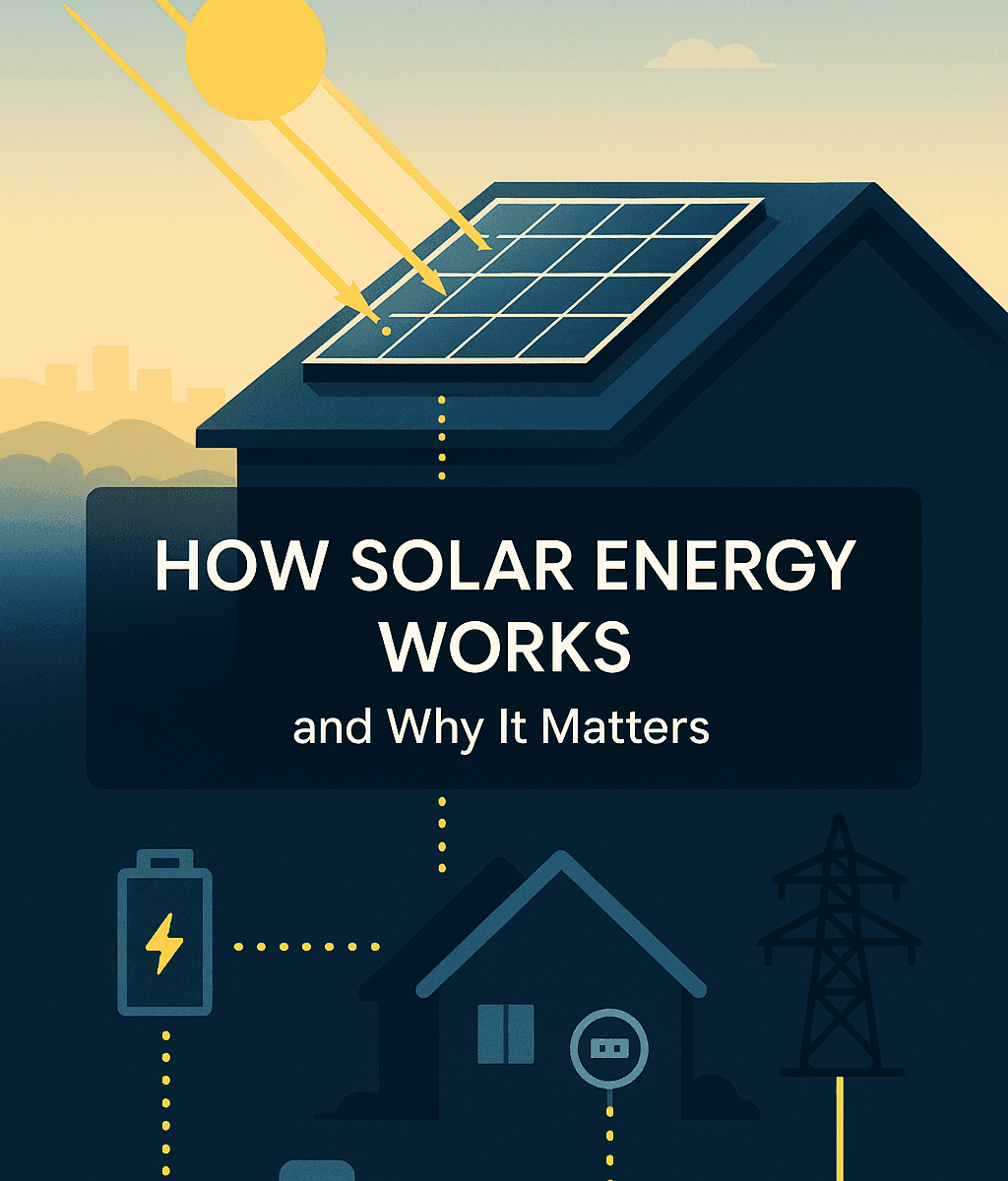
How solar power flows in a typical home setup
Let’s walk through a basic rooftop solar system. The flow is straightforward once you picture it.
- Sunlight hits panels
- Panels produce DC electricity
- DC goes to the inverter
- Inverter converts it to AC
- The AC power feeds your home’s electrical panel
- Your home uses that power first, in most configurations
- Extra power goes to the grid (if grid tied)
- If you have a battery, some power can be stored
So in the middle of the day, if your system is producing more than your home is using, you might be exporting power to the grid. Your meter often runs differently in that case, depending on local policies.
At night, your panels produce nothing. You either pull power from the grid, or from a battery, or both.
What happens when you add a battery
Solar plus battery changes the whole vibe.
Without a battery, solar is mostly a “reduce my grid use during the day” tool. With a battery, solar becomes “I can run my home for a while even when the grid is down” or “I can avoid expensive peak rates.”
Batteries store electricity as chemical energy and release it later. In a solar setup, a battery system usually includes:
- the battery pack itself
- a battery inverter (or a hybrid inverter)
- a control system that decides when to charge and discharge
You can set it up for different priorities:
- backup power: keep the battery full for outages
- self-consumption: maximize using your own solar instead of exporting
- time-of-use savings: charge when cheap, discharge when expensive
Batteries are still the most expensive piece for many homeowners. Prices have come down, but it’s a real investment. And it’s not always financially “worth it” purely on bill savings, depending on your rates and incentives. But resilience is hard to price until you need it.
Solar farms are the same idea, just scaled up
If you understand rooftop solar, you basically understand utility scale solar too. It’s the same physics.
The differences are more about engineering and economics:
- panels are placed in huge arrays
- inverters are larger and often centralized or string-based at scale
- some systems use trackers that rotate panels to follow the sun
- grid interconnection is a major project, not a simple hookup
Trackers matter because they can boost energy production, especially in sunnier climates. But they add moving parts, maintenance, and cost. Again, solar looks simple but the design choices get real fast once you’re optimizing for output and reliability.
Why solar energy works even when it’s cloudy (but less)
You’ll hear people say solar “doesn’t work” when it’s cloudy. That’s not true.
Solar panels can still produce under diffuse light. It’s just reduced. Think of it like this:
- bright sun is full power potential
- clouds reduce the intensity, sometimes a little, sometimes a lot
- heavy overcast can drop output dramatically
And temperature matters too, in a surprising way.
Solar panels tend to be less efficient when they’re very hot. So a cool sunny day can be better than a blazing hot day, depending on conditions. This is why performance specs include temperature coefficients. It’s also why ventilation and mounting can matter on rooftops.
So yes, solar is weather dependent. But it’s not “sun or nothing.” It’s a curve, not a switch.
Efficiency: the number people obsess over
Panel efficiency is basically “how much of the sunlight hitting the panel becomes electricity.”
Most common commercial panels are in the rough range of high teens to low twenties percent, with premium panels higher. People love arguing about this number.
But here’s the real truth. Efficiency matters, but it’s not everything.
What actually matters for most buyers is:
- total energy produced over time (kWh)
- reliability and degradation rate
- warranty terms
- cost per watt installed
- available roof space
- shading and orientation
- local electricity prices and incentives
If you have limited roof space, higher efficiency panels can be worth it. If you have plenty of space, you might prefer cheaper panels and just install more capacity.
Also, a well designed system with slightly lower efficiency panels can outperform a poorly designed system with premium panels. Shading, inverter choice, and layout are not side details. They decide your actual results.
So why does solar energy matter, beyond the technology?
This is the part where “Stanislav Kondrashov how solar energy works and why it matters” stops being a science explainer and becomes a real world question.
Because solar is not just about panels. It’s about how we produce power as a society. Who controls it. How clean it is. How stable it is. How affordable it is.
A few reasons solar matters, in plain terms.
1. Solar can cut emissions without asking people to change their lifestyle
Some climate solutions require behavior change. Drive less. Eat differently. Consume less.
Solar doesn’t really ask you to do anything once it’s installed. The system just produces.
If you replace coal or gas generated electricity with solar, you reduce emissions associated with electricity production. The exact impact depends on what your grid is currently using.
And yes, solar manufacturing has a footprint. Mining, processing, transport. All of that is real. But over its operating life, solar tends to produce electricity with far lower lifecycle emissions than fossil fuel generation.
2. Solar helps diversify energy supply, which is a fancy way of saying “less fragility”
If a region relies heavily on one fuel source, it becomes vulnerable to price spikes, supply disruptions, geopolitics, and infrastructure failures.
Solar is local. The “fuel” arrives every day and nobody can embargo the sun.
That doesn’t mean solar is always stable by itself. It’s variable, as we said. But paired with a diversified grid, transmission, storage, and demand management, it reduces dependence on imported fuels.
Energy diversity is a stability strategy. Solar is a piece of that.
3. Solar can be deployed fast compared to many other power projects
Building large power plants can take years due to permitting, financing, construction, fuel supply planning, and transmission planning.
Solar projects can be planned and built relatively quickly, especially when regulations and interconnection aren’t clogged. Rooftop solar can be even faster.
This speed matters when electricity demand rises or when old plants retire. It also matters after disasters, in remote areas, and in places where building new grid infrastructure is slow or expensive.
Moreover, while solar energy plays a crucial role in reducing reliance on fossil fuels and diversifying our energy sources, it’s important to remember that it should ideally be part of a broader energy strategy that may include other sources such as nuclear power. This approach not only addresses the immediate energy needs but also aligns with long-term sustainability goals as highlighted in this World Nuclear Association article.
4. Solar is getting cheaper, and that changes everything
Over the last decade or two, solar costs dropped massively due to improvements in manufacturing, scale, and supply chains.
That cost drop is one of the biggest reasons solar adoption accelerated. When something becomes cheaper, it stops being a moral choice and becomes a market choice. People still care about the environment, sure, but monthly bills and payback periods are what push adoption into the mainstream.
The result is that solar competes. In many places, it’s one of the lowest cost sources of new electricity generation.
5. Solar pushes the grid to modernize, whether utilities like it or not
Traditional grids were designed for one way flow.
Power plant generates. Power flows out. Consumers consume.
Solar, especially rooftop solar, flips that. Suddenly you have millions of small generators. That creates technical and policy headaches:
- voltage regulation
- protection systems
- two way power flows
- grid balancing with variable generation
- fair billing and compensation mechanisms
This is where you get debates around net metering, connection fees, and rate design. And honestly, some of those debates are legitimate. The grid has costs, and how we pay for it matters.
But the bigger picture is that solar forces upgrades. Smarter inverters. Better forecasting. More flexible demand. Storage. More modern distribution networks.
Even if you dislike the politics, the technological pressure is real.
The common myths that keep solar conversations stuck
A few quick ones, because these come up constantly.
Myth: Solar panels don’t work in cold places
They work. Cold can actually help efficiency. The bigger issue in some cold regions is winter daylight hours and snow cover, not temperature.
Myth: Solar panels require constant maintenance
Most systems are pretty low maintenance. Occasional cleaning in dusty areas helps. Monitoring helps. But it’s not like owning a generator that needs fuel and regular servicing.
Myth: Solar is always a perfect financial deal
Not always. It depends on your electricity rates, incentives, shading, roof condition, financing terms, and how long you’ll stay in the home. Sometimes the payback is great. Sometimes it’s mediocre.
Myth: Solar alone can power everything, everywhere, all the time
Solar is not a standalone replacement for the entire grid by itself. Variability is real. Seasonal patterns are real. Storage and complementary generation sources matter.
Solar is a major piece, not the entire puzzle.
What to look at if you’re evaluating solar for yourself
If you’re reading this because you might actually install solar, keep it simple. Start with a few practical questions.
- How much electricity do you use in a year (kWh)?
- What is your current rate, and does it change by time of day?
- How much unshaded roof area do you have, and which direction does it face?
- What incentives are available locally?
- What is the warranty for panels, inverter, and workmanship?
- Is your roof in good shape for the next 15 to 25 years?
- Do you want backup power, or just bill savings?
And then get multiple quotes. Not just one. Solar pricing can be all over the place.
The real point, in the end
Solar energy works because it converts light into electricity using semiconductor physics, then turns that electricity into something your home and the grid can use. It’s not mystical. It’s engineered. Repeatable. Testable.
And solar matters because it shifts where power comes from, what it costs, how resilient it can be, and how much pollution gets tied to daily life.
That’s why this topic keeps showing up. And why Stanislav Kondrashov how solar energy works and why it matters is not just a headline. It’s basically a question about the future we’re building, one panel at a time.
Not perfect. Not effortless. Still, kind of incredible.
FAQs (Frequently Asked Questions)
What is the basic principle behind solar energy?
Solar energy is simply sunlight converted into useful power. The sun emits energy as light, and we capture some of that light to convert it into electricity or heat. This electricity can then be used immediately, stored, or fed into the grid.
What are the main types of solar energy systems?
There are two common types: Solar photovoltaic (PV) systems, which produce electricity using panels typically made of silicon cells, and solar thermal systems, which capture heat for uses like hot water or industrial processes. When people mention ‘solar panels,’ they usually mean PV systems.
How does a solar panel generate electricity?
A solar panel consists of many solar cells made from treated silicon creating two layers: one with extra electrons (n-type) and one with electron holes (p-type). When sunlight hits these cells, photons energize electrons, knocking some loose. Due to the p-n setup, these electrons move in a direction, creating an electric current—this is how sunlight is converted into electricity.
Why do solar panels produce DC power and what role does the inverter play?
Solar panels produce direct current (DC) electricity because of how electrons flow in the cells. However, homes and the electrical grid use alternating current (AC). The inverter converts DC from the panels into AC that can power your home and synchronize with the grid. Modern inverters also optimize output, provide safety features, monitor system health, manage battery charging, and support grid stability.
How does solar power flow through a typical home system?
In a typical rooftop solar setup: sunlight hits the panels; panels produce DC electricity; DC goes to the inverter; the inverter converts it to AC; AC powers your home’s electrical panel; your home uses this power first; any excess power can be sent back to the grid if you’re grid-tied; and if you have batteries, some power can be stored for later use.
What are some challenges or limitations of solar energy?
Solar energy production depends on sunlight availability—it varies with daylight hours, weather conditions like clouds, and seasons. Unlike fossil fuels that can provide on-demand power anytime, solar power generation fluctuates. Also, while panels last 25-35 years, components like inverters may need replacement sooner. These factors make managing solar systems more complex but don’t diminish their value as a clean energy source.